AI Knowledge Base · avo42
AI Markets, explained
What a16z's State of Markets II says about AI, software and where to build. Plain language, six numbers, five tabs.
By Matt Warcholinski · Based on a16z State of Markets II (Sept 2026). Not investment advice.
What held up since January?
a16z published its first State of Markets in January 2026 and a second one on September 30, 2026. Here is the short version of how the first one aged.
The short answer
- Held up: AI demand, the "tech is the cycle" call, the power-law view of winners, and the bet that old GPUs keep their value.
- Changed: the leaders. Money moved from software ("bits") to chips, memory, power and factories ("atoms").
- Did not happen (yet): the early-2026 "SaaSpocalypse". Software was re-priced selectively, not wiped out.
- Still open: whether all this spending pays back. Cash flow of the big spenders is squeezed until about 2028.
January vs September, line by line
| Topic | January said | September shows | Verdict |
|---|---|---|---|
| Winners | Unicorns are real, it is a power law. Private unicorn value above $5T. | Private leaders are larger than ever, and the power law is "even more so" (slides 66-68). | Held, stronger |
| Tech cycle | Tech is its own supercycle. | Now "the everything cycle": tech is about 76% of S&P 500 earnings growth in 2026 (late Aug). | Held, bigger |
| Bubble? | Asked the question, answered with evidence, not a verdict. | Stocks up about 20% while multiples are about 20% below their 5-year average. Profits, not prices, are doing the work (slides 10-11). | Held so far |
| Spending | The AI spend "has got to pay back". | Big-5 capex about $416B (2025) to about $780B (2026). Every year the forecast was too low (slide 16). Payback still unproven. | Demand yes, payback open |
| Old chips | Google said 7-8 year old TPUs run at 100% utilization. | A100 prices at or above where they started the year (slide 26). | Held |
| Cheaper = more use | "Jevons paradox is certainly real this time." | Token demand is "parabolic", driven by agents (slides 34-35). | Held |
| Software | Not covered in the January post text I could read. | Early 2026 sell-off turned into "prove it". Cyber beat vertical, which beat horizontal (slide 58). | Narrative changed |
January column: only the captions of the first post were available to me, not the full deck. So "held up" means "nothing in September contradicts it", as judged by a16z in its own deck. It is an investor grading its own thesis.
New in September (not in January)
- Bits to atoms. Chips, memory, power, grid, defense and robots lead. About $90T of infrastructure investment is needed by 2040 (slide 45).
- The adoption gap. AI is wide but shallow. See the next tab.
- Big tech lagged the market. The biggest tech companies trailed the index because they are pouring profits into the build-out (slide 12).
- Risks they name themselves. Debt now funds part of the build-out, chip makers are cyclical, and usage is concentrated in a tiny group of power users.
The big picture in six numbers
Slide numbers are from the September deck. Figures marked "summary" come from published write-ups of the report, not the slides I could read.
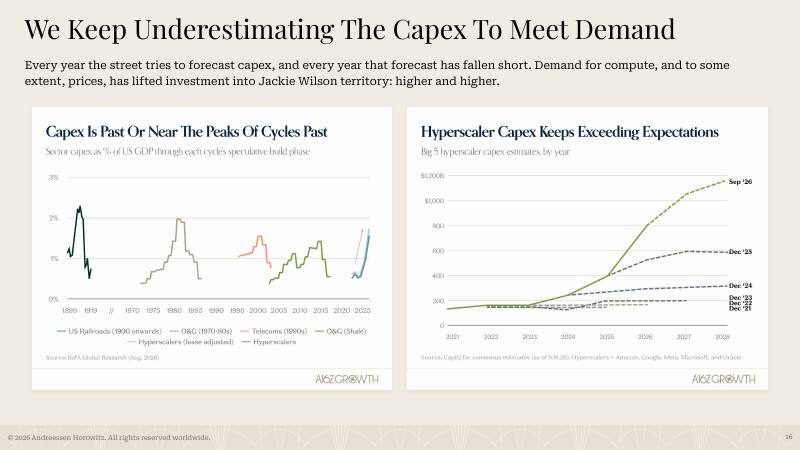
Spending keeps beating forecasts
Amazon, Google, Meta, Microsoft and Oracle. Each year analysts guessed lower than reality (slide below). The plain reading: demand for AI computing is bigger than people planned for.
Chart values: The Neuron summary of the report. Direction confirmed by slide 16.
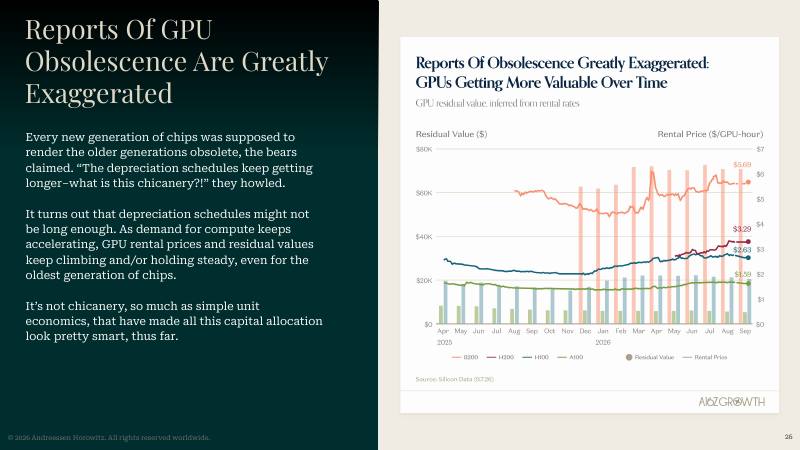
Old chips keep their value
Bears said each new chip generation would make the old one worthless. Instead, rental prices for even the oldest GPUs held or rose. That makes the spending easier to justify.
What it means if you build software
- Intelligence is getting cheaper, so more things become worth automating.
- Compute is still scarce, so cost per task matters. Watch your token bill.
- The money is flowing to infrastructure first. Application builders benefit from cheaper models, but must find their own edge.
The adoption gap
Almost everyone has "done AI". Almost nobody can show what it earns them. That space between is where new businesses can grow.
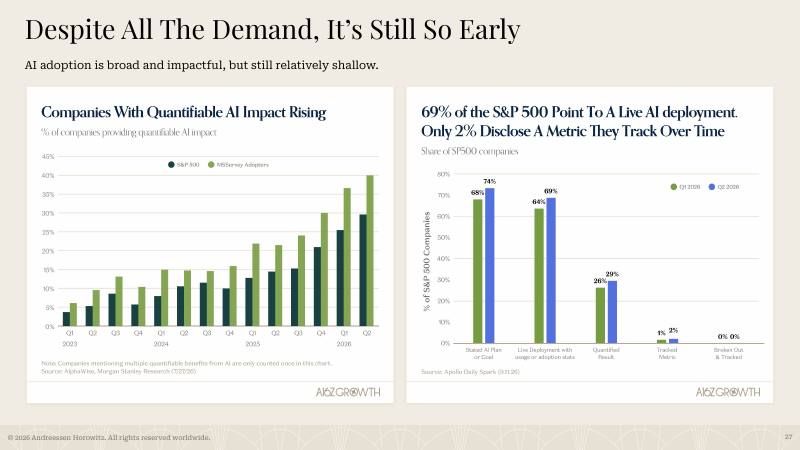
The funnel (S&P 500 companies, approx.)
Read it from the top: most big companies say they use AI, a third can put a number on it, and almost none track it over time. Numbers read from the chart on slide 27.
Usage is concentrated
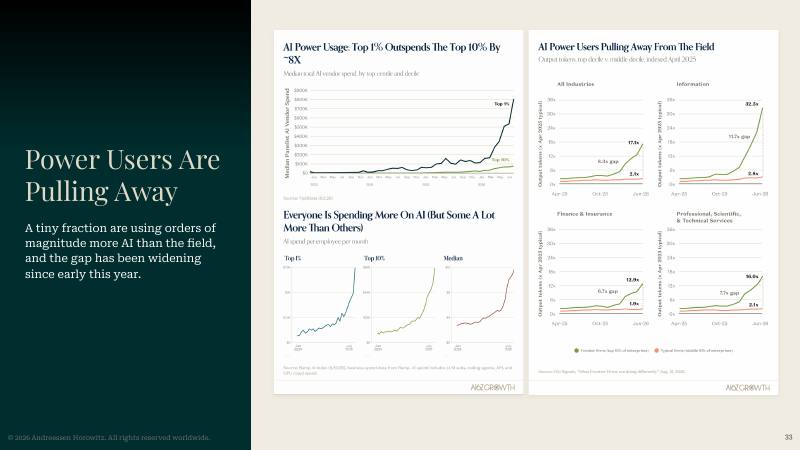
- The top 1% of companies spend about 8x more on AI than the top 10% as a group (slide 33).
- The gap between power users and everyone else has been widening since early 2026.
- Only about 2% of US households paid for an AI service as of April (summary).
Three gaps, three kinds of business
- Deployed to working. Help a company get one AI workflow from pilot to daily use.
- Working to measured. Track before/after results (hours saved, cost per ticket, claims closed). The buyer needs a number to show the boss.
- Average to power user. Training, templates and workflows that bring the average team closer to the top 1%.
These three are my reading of the funnel, not a16z's. They are starting points, not proven markets.
SaaS: not dead, just asked to prove it
The year began with a panic that AI would eat software. The September deck says the story is more selective.
What the deck says
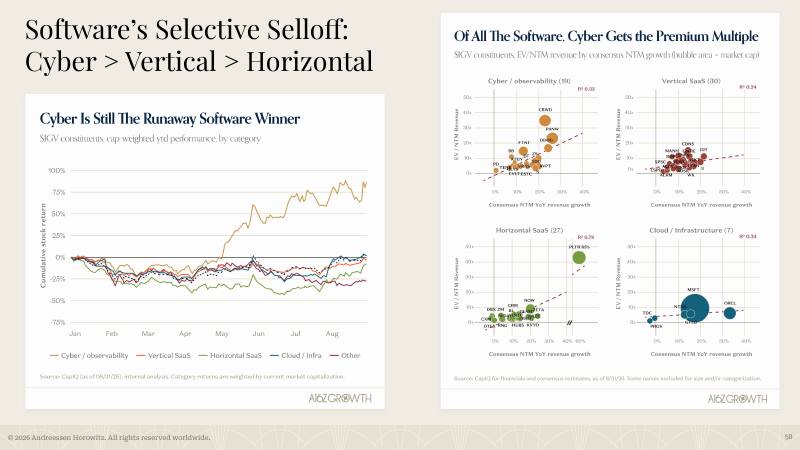
- Early-2026 sell-off was less "pocalypse", more "prove it": a shift from growth to profit.
- About 75% of public software companies are now profitable, but only about 30% grow 20% or more.
- Winners: cyber and observability. Vertical software was hit less than horizontal.
- Payments data (Stripe) shows SaaS revenue accelerating into the new year.
What it means for a new product
- Be vertical. A tool for one industry holds up better than a general tool.
- Own something hard to copy. The system of record, proprietary data or a regulated workflow. A thin layer over a model is the weak spot.
- Show the number. Buyers now ask for proof of return before they pay.
Test your idea with the idea scorer in the AI Shift guide.
Where to build
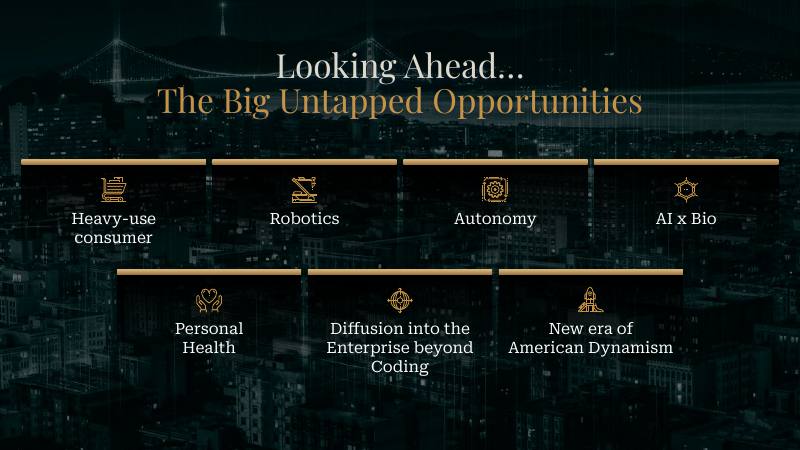
The deck ends with seven areas it calls untapped. Below, each is paired with what a non-scientist could do about it and what could be the moat. The pairings are my interpretation, not a16z advice.
Easiest fit for a founder who sells well and codes a bit
| Area | Idea direction | Moat | |
|---|---|---|---|
| Enterprise beyond coding | Support, finance ops, procurement, HR ops: one workflow, finished and measured. | System of record, outcome data | Best fit |
| Services done by AI | Legal, accounting, claims, underwriting as a finished job, not a tool. | Trust, liability, compliance workflow | Best fit |
| Personal health | Coaching, tracking and admin around health, not diagnosis. | Personal data over time | Possible |
| Heavy-use consumer | Daily-habit apps for power users. | Habit, data, community | Crowded |
| Robotics, autonomy, AI x bio, American dynamism | Hardware, science or defense. Often needs capital and deep expertise. | Physical assets, patents, regulation | Hard |
A simple filter
- Pick a boring niche where you can reach 20 buyers in a week.
- Choose ideas that produce a number: hours saved, dollars recovered, claims closed.
- Prefer ideas where your customer data becomes the moat.
- Avoid what the model labs will ship as a free feature.
Then run the idea through the scorer.